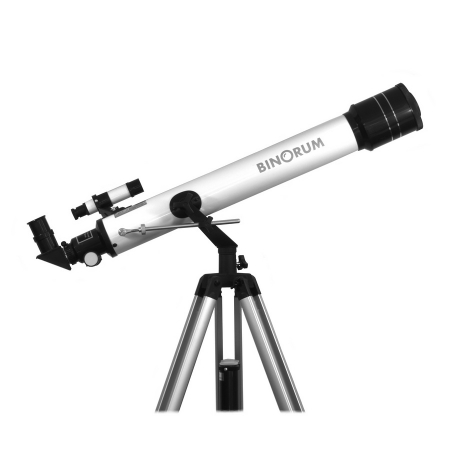
Binorum Bahtinov Focusing Mask 60-90mm
The Binorum Bahtinov focusing mask is a unique and essential tool for achieving perfect focus in astrophotography. This precision-designed mask fits telescopes and camera lenses with outer objective diameters from 60mm to 90mm, transforming the challenging task of critical focusing into a simple, objective process that takes seconds rather than minutes of trial and error.
What Is a Bahtinov Mask?
Invented by amateur astronomer Pavel Bahtinov in 2005, the Bahtinov mask is an optical focusing aid that uses diffraction patterns to indicate precise focus. The mask features a specific pattern of slots cut at carefully calculated angles. When placed over your telescope aperture and pointed at a bright star, these slots create distinctive diffraction spikes that form a characteristic pattern around the star image.
The genius of the design lies in how the diffraction pattern changes with focus. At perfect focus, the central spike aligns precisely between two angled spikes, creating a symmetric pattern. Any defocus - even by tiny amounts invisible to the naked eye - causes the central spike to shift left or right, providing immediate visual feedback about focus direction and magnitude.
Why Bahtinov Masks Are Superior
Traditional focusing methods rely on subjective judgment - making stars "as small as possible" or observing when they appear "sharpest." These methods suffer from several problems:
Atmospheric seeing causes star images to blur and dance, making it difficult to judge true focus. What appears sharp one moment may shimmer the next, leading to inconsistent results.
Thermal effects in the telescope cause focus to shift as equipment cools to ambient temperature. By the time you think you've achieved focus, thermal changes may have shifted it again.
Human perception limitations make it hard to detect the subtle differences between near-focus and perfect focus, especially with smaller stars or lower magnifications.
The Bahtinov mask eliminates these subjective elements. The diffraction spike pattern provides an objective, unambiguous indicator of focus state. You're not judging whether a star looks sharp - you're simply aligning a spike pattern, which is far easier and more reliable. Even beginners can achieve precision focus that rivals or exceeds what experienced astrophotographers accomplish through traditional methods.
How to Use the Bahtinov Mask
Step 1 - Installation: Attach the mask to the front of your telescope, ensuring it sits centered and secure over the objective lens or primary mirror opening. The mask should cover the full aperture.
Step 2 - Target Selection: Point your telescope toward a moderately bright star (magnitude 2-4 works well). Avoid very bright stars that may saturate your camera sensor, and avoid very faint stars that produce weak diffraction spikes.
Step 3 - Camera Setup: Activate your camera's live view mode and zoom in digitally on the star image. You should see the characteristic Bahtinov diffraction pattern - typically showing three sets of spikes around the star.
Step 4 - Achieve Focus: Observe the central spike (usually running vertically or at a specific angle). If focus is off, this spike will be offset to the left or right of the center position between the two angled spikes. Slowly adjust your telescope's focuser, watching the central spike move. Continue adjusting until the central spike sits precisely centered between the angled spikes, forming a perfectly symmetric pattern.
Step 5 - Final Check: Once the pattern appears symmetric, make tiny focus adjustments back and forth to confirm you're at the exact focus point. The central spike should shift equally in both directions from center.
Step 6 - Begin Imaging: Remove the Bahtinov mask from your telescope. Your camera is now at optimal focus. Begin your imaging sequence on your target deep-sky object. Remember to refocus periodically during long imaging sessions as temperature changes may cause focus drift.
Advantages for Different Imaging Scenarios
Deep-Sky Imaging: Achieving critical focus is essential for resolving fine details in galaxies, nebulae, and star clusters. The Bahtinov mask ensures your optics perform at their peak resolution, revealing the maximum detail your telescope can deliver.
Wide-Field Astrophotography: When using camera lenses for wide-field imaging, the Bahtinov mask provides the same precision focusing advantage, ensuring sharp stars across the field.
Narrowband Imaging: When using narrowband filters (H-alpha, OIII, SII), focus can shift slightly compared to broadband. The Bahtinov mask allows quick refocusing when changing filters.
Remote Imaging: For remotely controlled telescopes or robotic observatories, the Bahtinov mask enables reliable automated focusing using image analysis of the diffraction pattern.
Construction and Compatibility
This Binorum mask features durable plastic construction with precisely manufactured slot patterns. The lightweight design won't stress your telescope tube or mounting, and the material resists warping from temperature changes or humidity.
The mask fits telescopes with outer objective diameters from 60mm to 90mm, accommodating:
- Small refractors (60-90mm aperture)
- Maksutov-Cassegrain telescopes (typically 90mm models)
- Small Schmidt-Cassegrain telescopes
- Camera lenses with large front elements (measure the outer diameter of the lens barrel or filter thread housing)
Important: Measure your telescope's outer diameter - not the aperture, but the physical diameter of the tube or lens cell where the mask will sit. The mask must cover the full aperture while sitting securely on the outer housing.
Tips for Best Results
- Use live view at high magnification (10× digital zoom or more) to see the diffraction spikes clearly
- Choose stars that are well-elevated above the horizon where atmospheric disturbance is reduced
- Allow your telescope to reach thermal equilibrium before final focusing
- In windy conditions, wait for momentary calms to make your final focus adjustment
- Take a test exposure after removing the mask to verify focus on your actual target
- If using an autofocuser, you can analyze Bahtinov mask images programmatically for automated focusing
Technical Specifications
Compatible Outer Diameter Range: 60-90mm
Material: Precision-molded plastic
Pattern Type: Bahtinov diffraction grating
Weight: Lightweight (minimal load on telescope)
Color: Typically black to minimize light scattering
Application: Visual focusing aid for astrophotography and critical observation
Transform Your Astrophotography
Perfect focus separates mediocre astrophotography from exceptional results. The Binorum Bahtinov mask removes the guesswork, frustration, and wasted time from achieving critical focus. Whether you're imaging faint galaxies, colorful nebulae, or testing a new optical system, this simple tool ensures you're always working at optimal focus - where your equipment performs at its absolute best and your images capture the finest details the universe has to offer.