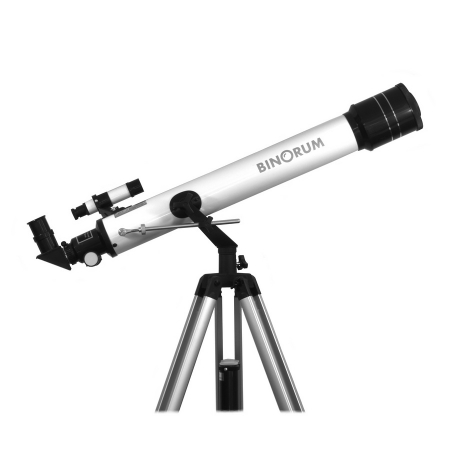
Mirror Telescopes - Reflectors
Astronomical telescopes that use a mirror as the objective lens are commonly known as Newtonian or mirror reflectors. The primary mirror can be parabolic (for large diameter objectives) or spherical (for small diameter objectives). The main advantage of reflectors is the complete absence of chromatic aberrations in the center of the field of view, providing reliable color reproduction and detail contrast. Another strong point is the high light-gathering power of reflectors, which positively affects both the field of view size during observations and image quality in astrophotography. The disadvantages of reflectors include: the need for regular collimation, considerable size, and the requirement for sturdy and stable mounts. Mirror telescopes are excellent for observing planets, moons, and deep-sky objects.
Astronomical telescopes utilizing a mirror as the main optical element work on the principle of light reflection from a mirrored surface. This design eliminates chromatic aberration because light does not pass through any glass that could cause color distortion. The most commonly used system is the Newtonian design, which includes a large parabolic mirror positioned at the rear of the tube that focuses light rays onto a small flat secondary mirror. This secondary mirror then reflects light into the focuser, where an eyepiece is inserted for viewing the final image. The result is sharp, high-contrast images free from the color fringing that can affect refractor telescopes.
Newtonian Mirror Telescopes
A Newtonian telescope is a reflecting telescope consisting of one concave (primary) mirror and one flat elliptical secondary mirror. This type of telescope is renowned for its simple construction and excellent price-to-performance ratio. When such a telescope is mounted on a rocker box altazimuth mount, it is called a Dobsonian, named after the creator of this mounting system. The Newtonian design has been a favorite among amateur astronomers for decades due to its effectiveness and affordability.
The advantages of Newtonian telescopes include their easy collimation (optical alignment) and lower risk of primary mirror dewing during humid nights, as the long tube serves as a dew shield. The open tube design also allows rapid temperature equalization between the air inside the tube and the surrounding environment, which improves observation quality. Additionally, the absence of a corrector plate means there are no additional optical surfaces to introduce aberrations or reduce light transmission.
Among the disadvantages is the open tube design, which allows dust and debris to easily enter and settle on optical components. In faster telescopes (with focal ratio f/6 and lower), coma may appear - an optical aberration that can be corrected with appropriate accessories. For larger Newtonian telescope models, their greater structural length poses higher demands on mount stability and mechanical properties. Regular maintenance and cleaning of the mirrors may also be required more frequently than with sealed optical systems.
Applications and Performance
Newtonian reflectors excel in deep-sky observation, particularly for nebulae, galaxies, and star clusters where light-gathering power is crucial. Their wide field of view capabilities make them ideal for sweeping the sky and locating faint objects. Many astrophotographers prefer Newtonian systems for their fast focal ratios and large apertures, which enable shorter exposure times and better signal-to-noise ratios. The absence of chromatic aberration also makes them suitable for both visual observation and imaging across the entire visible spectrum without the need for additional corrective optics.