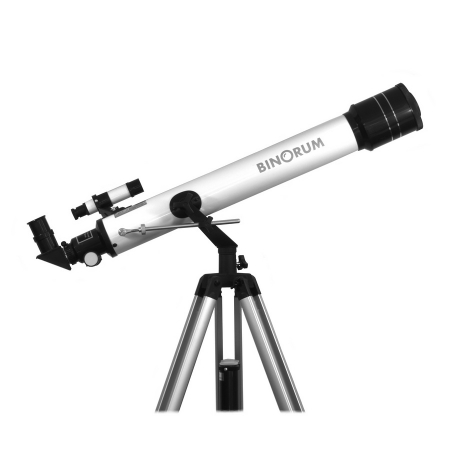
Diagonal prisms for telescopes - precision optics for comfortable observation
A diagonal prism is an indispensable accessory for every refractor and catadioptric telescope. It allows comfortable viewing without the need to assume awkward body positions, especially when observing objects at high angles above the horizon. Diagonal prisms for telescopes redirect the light beam by 90 degrees, providing ergonomic and pleasant observation of the night sky as well as terrestrial objects. Thanks to high-quality optical glass and precisely ground surfaces, these prisms achieve excellent light transmission and minimal optical distortion. Whether you are a beginner or an experienced observer, a good diagonal prism will transform your viewing sessions.
How a diagonal prism works and why you need one
The principle of a diagonal prism is based on total internal reflection of light on the inner surface of the optical glass. Unlike diagonal mirrors, a prism contains no metallic reflective coating that could degrade over time. Light reflects directly off the glass surface due to the physical phenomenon of total internal reflection, guaranteeing long service life and stable optical properties. The resulting image is bright, high-contrast, and free from unwanted color deviations. A diagonal prism is therefore the ideal choice for both astronomical and terrestrial observation purposes. Its robust construction ensures reliability even under demanding field conditions.
Key features of diagonal prisms
When choosing a diagonal prism, it is important to consider several technical parameters that determine the quality of the final image. The barrel diameter is one of the most critical factors, as it must match your eyepieces and focuser. The optical glass material, surface coatings, and angular precision all play a significant role in the overall performance of the prism. Below are the most important characteristics to look for:
- Clear aperture diameter - standard 1.25″ or 2″ to suit different eyepiece types
- Glass material - BK7 or higher-grade optical glass for minimal aberrations
- Surface treatment - broadband anti-reflection coatings increasing light transmission
- Reflection accuracy - 90° ± 1 arc minute for precise beam guidance
- Compatibility - standard threads for secure attachment to the telescope focuser
Advantages of a prism over a diagonal mirror
Many astronomers prefer a diagonal prism over a classic diagonal mirror for several compelling reasons. A prism generally provides higher reflectivity and better image contrast because it does not rely on a metallic coating susceptible to deterioration. It is also mechanically more robust and requires no special care for a reflective surface. For visual observation of planets, the Moon, and double stars, a prism is widely regarded as the premium choice. A quality diagonal prism can significantly enhance the overall visual impression of your observations and help you fully exploit the optical potential of your telescope. With proper use, a high-grade prism will serve you reliably for many years.
Types of diagonal prisms and their applications
Diagonal prisms are available in several designs tailored to different observing needs. The most common type is the standard 90-degree prism, which is ideal for visual observation of celestial and terrestrial objects alike. Amici prisms produce an erect, correctly oriented image and are particularly popular for daytime use and nature observation. Star diagonal prisms are optimized for astronomical use, where a slight image inversion is acceptable and optical throughput is the primary concern. Choosing the right type depends on your specific telescope, the objects you intend to observe, and your personal preferences as an observer. Our range covers all major types to ensure you find exactly the right match.
Choosing the right diagonal prism for your telescope
Our range includes diagonal prisms in various sizes and quality tiers, suitable for both beginners and experienced observers. Prisms with a 1.25″ barrel are compatible with the majority of standard eyepieces and are ideal for smaller refractors and catadioptric telescopes. Prisms with a 2″ barrel offer a wider true field of view and are well suited to more powerful instruments. All products in our range have undergone strict quality control and meet high standards for optical performance. When selecting a prism, it is worth paying attention to the coatings applied to the glass surfaces, as these directly affect light transmission and image brightness. We are happy to help you choose the prism that best matches your specific telescope and observing style.
Care and maintenance of diagonal prisms
Proper care of a diagonal prism is simple and ensures lasting optical performance. The external glass surfaces should be cleaned only when necessary, using a soft brush or optical cleaning cloth to remove dust and debris. Avoid touching the optical surfaces with your fingers, as skin oils can leave residues that are difficult to remove. When not in use, store the prism in its protective case away from moisture, dust, and direct sunlight. Unlike diagonal mirrors, prisms do not require periodic recoating, which makes them a low-maintenance and cost-effective long-term investment. Following these basic precautions will keep your prism in excellent condition for decades.