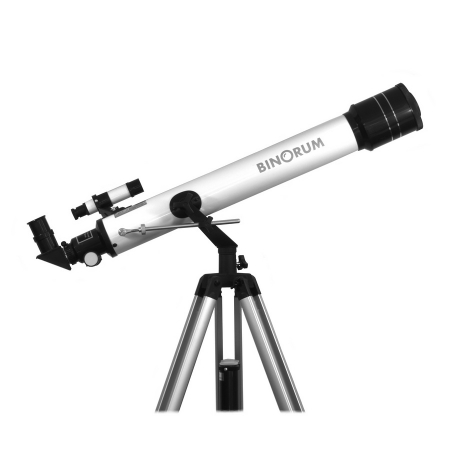
Binorum Laser Collimator 2″/1.25″ Universal Alignment Tool
Essential Precision Tool for Newtonian Telescopes
The universal Binorum Laser Collimator provides precise alignment capabilities for Newtonian reflector telescope systems. For any telescope to perform its optical function optimally, it must be properly collimated - meaning aligned so that the optical axis of the primary mirror coincides exactly with the optical axis of the focuser tube. Proper collimation is fundamental to achieving the image quality your telescope is capable of delivering.
Understanding Collimation
Collimation is the process of aligning the optical and mechanical components of a telescope so that the quality of the resulting image approaches the theoretical limit of resolving power and imaging capability inherent in that telescope's design. Even the finest optics will deliver disappointing performance if the optical train is misaligned. Collimation ensures that light rays traveling through your telescope converge precisely at the focal point, producing sharp, well-defined images of celestial objects.
Modern Laser Collimation Technology
Collimation using a laser collimator represents a relatively new and highly precise methodology that has revolutionized telescope maintenance. While various collimation methods can achieve identical results when executed with accurate tools and proper technique, laser collimation offers several unique advantages that make it the preferred choice for many astronomers. The precision and ease of use have made laser collimators increasingly popular among both amateur and experienced observers.
Key Advantages of Laser Collimation
The laser collimator incorporates its own light source, enabling you to perform collimation after darkness falls without requiring any additional equipment or external illumination. This self-contained capability proves invaluable when you arrive at an observing site and discover your telescope needs alignment adjustment before the night's session can begin.
Unlike collimation performed using passive tools such as sight tubes or Cheshire eyepieces, laser collimation doesn't require your eye to be precisely positioned in line with the eyepiece and crosshair. You also avoid the tedious procedure of alternating between viewing the collimation target and looking into the distance to check alignment. The laser beam provides an immediate, unambiguous visual reference that makes the alignment process straightforward and efficient.
Technical Specifications
- Compatible telescope types: Newtonian reflectors (all sizes)
- Barrel sizes: Dual 2″ (50.8mm) and 1.25″ (31.7mm) compatibility
- Laser type: Class 2 laser diode (safe for astronomical use)
- Laser wavelength: Typically 635-650nm (red)
- Power source: Battery operated (batteries typically included or specified)
- Construction: Precision-machined aluminum housing
- Adapter system: Removable adapter for 1.25″ focusers
- Centering accuracy: High-precision barrel ensures accurate optical axis alignment
Universal Dual-Size Compatibility
The Binorum Laser Collimator features dual 2″/1.25″ compatibility, making it universally applicable across the entire range of Newtonian telescopes. The collimator body fits standard 2″ focusers directly, while an included adapter sleeve allows secure installation in 1.25″ focusers. This versatility means a single collimator serves all your Newtonian telescopes, from compact tabletop reflectors to large Dobsonian instruments.
How Laser Collimation Works
The laser collimator inserts into the telescope focuser just like an eyepiece. When activated, it projects a precise laser beam down the optical tube toward the primary mirror. The beam reflects off the primary mirror to the secondary mirror, then back toward the laser collimator. Proper collimation is achieved when the reflected laser spot returns to the exact center of the collimator's target, indicating perfect optical alignment throughout the system.
Collimation Procedure Overview
Insert the laser collimator into your telescope's focuser (using the 1.25″ adapter if necessary). Activate the laser and observe where the beam strikes the primary mirror center spot. Adjust the secondary mirror screws until the laser dot centers on the primary mirror's center mark. Then adjust the primary mirror cell screws until the reflected laser spot returns precisely to the center of the collimator's target. Fine-tune as needed until the entire optical path is perfectly aligned.
When to Collimate Your Telescope
Newtonian telescopes require periodic collimation, especially after transport or if subjected to temperature changes or physical impacts. Many observers check collimation at the beginning of each observing session. Symptoms of poor collimation include asymmetric star diffraction patterns, elongated star images (particularly at high magnification), reduced contrast on planetary features, and overall soft or blurry images that don't improve with focusing.
Advantages Over Other Collimation Methods
Compared to star testing (collimating on an actual star), laser collimation can be performed during daylight or before astronomical targets are visible. Unlike sight tubes that require precise eye positioning and good lighting, the laser provides an objective reference independent of viewing conditions. Cheshire collimators work well but require external light sources and careful alignment of your viewing angle - the laser eliminates these variables.
Safety Considerations
Laser collimators typically employ Class 2 lasers, which are safe for brief direct viewing but should not be stared into intentionally. Always follow safety guidelines provided with the collimator. Never point the laser toward people, aircraft, or reflective surfaces that might redirect the beam unexpectedly. Use the laser only for its intended collimation purpose.
Maintenance and Storage
Store the laser collimator in a protective case when not in use to prevent dust accumulation on the optical surfaces and protect the precision barrel from impacts. Remove batteries during long-term storage to prevent corrosion. Periodically verify the collimator itself remains properly aligned by checking that the laser barrel sits concentrically within its housing - a miscalibrated collimator will prevent accurate telescope alignment.
Why Choose Binorum Collimation Tools
Binorum laser collimators are manufactured with precision-machined components to ensure accurate barrel concentricity - critical for reliable collimation results. The robust construction withstands regular field use while maintaining calibration accuracy. Quality laser diodes provide bright, easily visible beams even in partially lit conditions. Binorum combines professional-grade precision with accessible pricing, making accurate telescope maintenance tools available to astronomers at all experience levels. Proper collimation is essential for realizing your telescope's full optical potential - the Binorum Laser Collimator makes this critical maintenance task quick, accurate, and straightforward.