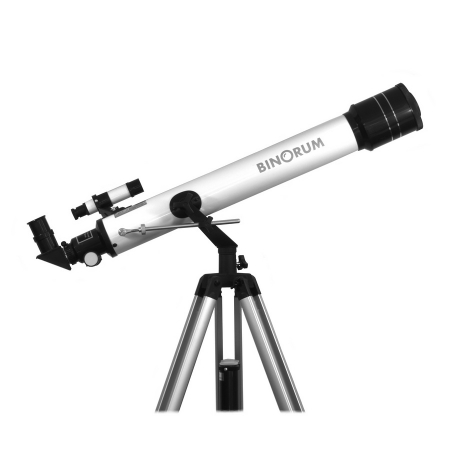
Binorum Planetary Pro 5mm 58° 1.25″ Planetary Eyepiece
The Binorum Planetary Pro 5mm represents the high-magnification end of serious planetary observation, delivering the power needed to resolve fine atmospheric details on Jupiter, split Saturn's Cassini Division, and track surface features on Mars. Combining a sophisticated six-element optical design with an unexpectedly generous 58° apparent field of view and long eye relief, this eyepiece achieves what many short focal length designs cannot - delivering razor-sharp, high-contrast planetary images without forcing observers to press uncomfortably close to the lens.
High-Power Planetary Specialist
At 5mm focal length, this eyepiece targets the magnification range where planetary detail truly comes alive. When paired with common telescope focal lengths, the Planetary Pro 5mm delivers magnifications ideally suited for studying:
- 750mm telescope: 150× magnification
- 1000mm telescope: 200× magnification
- 1250mm telescope: 250× magnification
- 1500mm telescope: 300× magnification
This magnification range (150× to 300×) represents the sweet spot for planetary observation with amateur telescopes between 4 and 10 inches aperture, allowing you to push atmospheric seeing conditions while maintaining image brightness and contrast. The 5mm focal length is particularly valuable when observing planets at opposition, when they appear largest and brightest in Earth's sky.
Optimized Six-Element Optical Formula
The Planetary Pro 5mm employs a carefully balanced six-element configuration that delivers premium orthoscopic and Plössl-level performance while offering significantly superior viewing comfort. This optical formula achieves three critical objectives simultaneously:
Exceptional on-axis sharpness: Planetary observation demands perfection at the center of the field where Jupiter's Great Red Spot, Saturn's ring divisions, and Martian polar caps reside. The six-element design prioritizes center-field performance, delivering pinpoint star images and crisp planetary detail exactly where it matters most.
Controlled lateral color: At high magnifications, even minor chromatic aberration becomes glaringly apparent as colored halos around bright planets. The Planetary Pro's optical formula virtually eliminates lateral color aberration, ensuring that Venus appears as a pure white crescent and Jupiter's cloud bands display their authentic beige and brown hues without purple or green fringing.
Minimal light scatter: Short focal length eyepieces can suffer from internal reflections that reduce contrast when viewing bright objects like the Moon or Jupiter. Every air-to-glass surface in the Planetary Pro features broadband multi-layer anti-reflection coatings, while complete internal blackening and precision-engineered baffles suppress scattered light. The result is high-contrast images that reveal subtle atmospheric features even on brilliantly reflective targets.
Remarkable Eye Relief for a 5mm Design
Perhaps the most distinctive feature of the Planetary Pro 5mm is its surprisingly long eye relief - a specification that separates this eyepiece from conventional short focal length designs. Traditional 5mm Plössl and orthoscopic eyepieces typically offer eye relief of just 4-6mm, forcing observers to press their eye uncomfortably against the lens and making eyeglass use virtually impossible.
The Planetary Pro 5mm delivers eye relief comparable to eyepieces with much longer focal lengths, providing several critical advantages:
Eyeglass compatibility: Observers with astigmatism who must wear corrective lenses while observing can actually use this eyepiece comfortably - a near-impossibility with conventional 5mm designs. The threaded rubber eyeguard adjusts to accommodate both eyeglass wearers (folded down) and non-eyeglass users (extended).
Reduced eye fatigue: Extended planetary observing sessions - particularly when sketching features or monitoring atmospheric changes over hours - become far less tiring when you don't need to maintain a precisely fixed eye position millimeters from the lens.
Elimination of kidney-beaning: The optical phenomenon where slight head movements cause black shadows to intrude into the field of view is virtually absent, making the observing experience more forgiving and enjoyable.
Ideal 58° Apparent Field of View
The 58° apparent field represents a carefully chosen compromise for high-power planetary work. While ultra-wide 82° or 100° eyepieces might seem appealing, they're often counterproductive for planetary observation:
Extra-wide fields require complex optical designs with seven, eight, or even nine lens elements. Each additional element introduces potential light scatter, chromatic aberration, and contrast loss - exactly what you don't want when trying to detect the subtle cloud bands on Jupiter or the delicate shading in Saturn's north polar hexagon.
The Planetary Pro's 58° field is wide enough to provide comfortable viewing with context - you can see a planet's moons in the same field while observing the disk - but not so wide as to compromise the optical simplicity and contrast that make planetary detail visible. At typical planetary magnifications, this translates to a true field of approximately 0.2° to 0.4°, enough to frame Jupiter and its Galilean satellites or Saturn with its rings and several moons simultaneously.
Premium Internal Construction
Every aspect of the Planetary Pro's mechanical design focuses on maximizing contrast and suppressing stray light:
- Complete internal blackening: The eyepiece barrel interior receives comprehensive matte black treatment to absorb any stray light that might otherwise reflect toward the observer's eye
- Micro-baffled edges: All internal lens spacers and baffles feature anti-reflection micro-texturing on their edges, breaking up potential light paths that could cause ghost images
- Blackened lens edges: The perimeter of each lens element is carefully blackened to prevent edge reflections that would reduce contrast
- Precision field stop: The field stop incorporates black anodization and is positioned to create a clean, sharp-edged field boundary without vignetting
Applications and Target Objects
Jupiter - Cloud Band Detail
Jupiter's rapid rotation (one complete turn every 9.9 hours) means atmospheric features are constantly changing. The 5mm Planetary Pro provides magnification sufficient to resolve:
- The North and South Equatorial Belts and their internal structure
- The Great Red Spot and smaller white ovals
- Festoons and turbulence along belt edges
- The subtle color variations between different atmospheric zones
- Transits of the Galilean moons and their shadows across Jupiter's disk
Saturn - Ring Division and Atmospheric Features
Saturn demands high magnification to reveal its subtleties. With the Planetary Pro 5mm you can observe:
- The Cassini Division in Saturn's rings (even in smaller 4-6 inch telescopes on nights of good seeing)
- The Encke Division in the A ring (challenging but possible in larger telescopes)
- Saturn's equatorial and temperate belts
- The north polar hexagon (when the pole is tilted toward Earth)
- Seasonal changes in ring brightness and planet coloration
Mars - Surface Features
When Mars reaches opposition every 26 months, its apparent size increases enough to make surface feature observation rewarding. The 5mm eyepiece reveals:
- The bright polar ice caps (especially prominent during Martian winter)
- Dark albedo features like Syrtis Major and Mare Acidalium
- Seasonal darkening and lightening of surface regions
- Occasional planet-wide dust storms
- The subtle orange-red color gradations across different regions
The Moon - High-Resolution Crater Study
While lower powers are traditional for lunar observation, the 5mm excels when you want to examine specific small features in detail:
- Interior terracing and central peaks in medium-sized craters
- Individual peaks in lunar mountain ranges
- Narrow rilles like Hadley Rille (Apollo 15 landing site)
- Small dome formations and their summit pits
- Fine detail in ray systems radiating from young craters
Venus - Phase Observation
Venus cycles through phases like the Moon as it orbits the Sun. The high magnification of the 5mm allows you to:
- Track the changing crescent and gibbous phases with precision
- Observe the "horns" extending when Venus is a thin crescent
- Detect subtle atmospheric shading (best with appropriate filters)
- Monitor Venus during daylight hours when it's far from the Sun
Double Stars - Challenging Splits
Some binary star systems require both high magnification and excellent optics to resolve. The Planetary Pro 5mm excels at splitting pairs with separations of 1-3 arc seconds, revealing color contrasts between stellar components and allowing you to appreciate some of the night sky's most beautiful double stars.
Seeing Conditions and Magnification Limits
The practical usefulness of a 5mm eyepiece depends heavily on atmospheric seeing conditions. The rule of thumb suggests maximum useful magnification of approximately 50× per inch of aperture (2× per millimeter) under excellent seeing, but this can drop to 30× per inch or less on nights of poor seeing when atmospheric turbulence is high.
Before selecting the 5mm for an observing session, start with a lower magnification eyepiece (10-15mm) and assess the steadiness of planetary images. If detail appears sharp and stable, progressively increase magnification. The 5mm should reveal more detail than lower powers - if it doesn't, atmospheric turbulence is limiting your view and a medium-power eyepiece might deliver better results that evening.
Optimal seeing conditions for using the Planetary Pro 5mm include:
- Planets positioned high in the sky (above 30° altitude) to minimize atmospheric thickness
- Calm, stable atmospheric conditions (check local "seeing forecasts" if available)
- Nights following cold front passages, which often bring stable air
- Observations several hours after sunset when atmospheric cooling stabilizes air columns
Technical Specifications
- Focal length: 5mm
- Apparent field of view: 58°
- Barrel diameter: 1.25 inches (31.7mm)
- Optical design: Six-element formula
- Coatings: Broadband multi-layer anti-reflection on all air-to-glass surfaces
- Eye relief: Long (comfortable for extended viewing and eyeglass use)
- Filter threads: Yes, 1.25-inch standard (M28.5 × 0.6)
- Eyeguard: Threaded rubber fold-down design
- Internal treatment: Complete blackening with anti-reflection baffles
- Field stop: Precision machined with black anodization
- Exit pupil formula: Telescope aperture (mm) ÷ magnification
Recommended Telescope Specifications
The Planetary Pro 5mm performs optimally with telescopes meeting these general criteria:
- Minimum aperture: 4 inches (100mm) - smaller telescopes may not gather sufficient light at the resulting magnifications
- Ideal aperture range: 5-10 inches (127-254mm)
- Focal ratio: f/6 to f/15 - slower focal ratios generally provide better planetary performance
- Focal length: 750mm to 2000mm for magnifications of 150× to 400×
To determine if the 5mm is appropriate for your telescope, calculate the exit pupil: divide your telescope's aperture (in mm) by the magnification produced. For comfortable viewing, the exit pupil should be at least 0.5mm, preferably 0.7mm or larger. For example, a 150mm telescope producing 200× magnification yields a 0.75mm exit pupil (150 ÷ 200) - excellent for planetary work.
Care and Handling
The precision optical surfaces and coatings deserve careful handling. Store the eyepiece in a protective case when not in use. Clean optical surfaces only when necessary, using proper lens tissue and optical cleaning fluid. Avoid touching the glass with fingers. Allow the eyepiece to reach ambient temperature before use to prevent condensation on internal elements. The threaded eyeguard should be adjusted gently and kept clean for smooth operation.
Complementary Accessories
To maximize the Planetary Pro 5mm's performance, consider these complementary accessories:
- Colored filters: #80A blue for Mars, #56 green for Jupiter, #25 red for Mercury and Venus against daylight sky
- Variable polarizing filter: Excellent for reducing lunar glare without color shift
- Barlow lens: A quality 2× Barlow can extend the 5mm to effective 2.5mm focal length for extreme magnification experiments on nights of exceptional seeing
Why Choose Binorum
Binorum has established itself as a respected name in amateur astronomy by consistently delivering professional-grade optical performance at prices that make advanced observing accessible to enthusiasts at all levels. The Planetary Pro 5mm exemplifies this philosophy, incorporating design elements and manufacturing precision typically reserved for eyepieces costing significantly more. Each Binorum eyepiece undergoes rigorous quality control testing to ensure it meets exacting optical standards for sharpness, contrast, and coating quality. The brand's focus on practical astronomy means features are chosen for real-world observational benefit - like the remarkable eye relief in this 5mm design - rather than marketing specifications. When you choose Binorum, you're selecting products designed by observers for observers, backed by years of experience understanding what amateur astronomers truly need to explore the solar system from their own backyards.