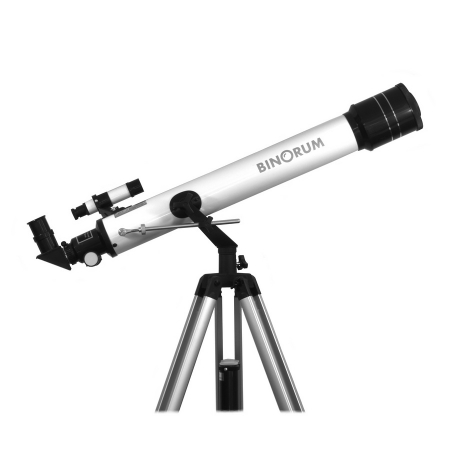
Binorum DeepSky SuperView 42mm 65° 2″ Eyepiece
The Binorum DeepSky SuperView 42mm represents the pinnacle of wide-field observing for deep-sky enthusiasts. This exceptional wide-angle eyepiece with its 2-inch barrel is an indispensable tool for spectacular observation of distant celestial objects. With its expansive 65° apparent field of view, the SuperView provides significantly more observing opportunities compared to traditional Plössl eyepieces, transforming your telescope into a true "space walk" portal to the universe.
Classic Erfle Design - Proven Wide-Field Performance
The DeepSky SuperView 42mm employs the time-honored Erfle optical configuration, a design originally created by German optical designer Heinrich Erfle in 1917 specifically for wide-field applications. The five-element arrangement in three groups (two achromatic doublets with a convex singlet element between them) delivers the perfect balance of field width, image quality, and affordability for serious deep-sky observation.
This proven optical formula provides:
- Expansive 65° apparent field: More than 30% wider than standard 50° Plössl eyepieces, revealing vast expanses of star fields
- Excellent central sharpness: Crisp, well-defined images across the majority of the field
- Good light transmission: Fully multi-coated optics on all air-to-glass surfaces maximize brightness for faint nebulae and galaxies
- Generous eye relief: Approximately 30mm of eye relief provides comfortable viewing even during extended observing sessions
The Advantage of 2-Inch Format
The 2-inch barrel diameter is not merely a mechanical specification - it represents a fundamental advantage for low-power, wide-field observing. Compared to the more common 1.25-inch format, 2-inch eyepieces offer:
Maximum possible field stop: The physical aperture through which light passes can be up to 46mm in diameter (compared to approximately 27mm for 1.25-inch eyepieces), allowing the eyepiece to capture the widest possible cone of light from your telescope.
Brighter images of extended objects: The larger exit pupil achievable with 2-inch eyepieces at low magnifications means more light enters your eye, making diffuse objects like nebulae and galaxies appear brighter and more detailed against the sky background.
Reduced vignetting: The generous barrel diameter eliminates the light cutoff that can occur with long focal length eyepieces in smaller formats, ensuring you see the full field your optics can deliver.
Premium viewing experience: Once considered exclusive to observatory-grade telescopes, 2-inch eyepieces are now the gold standard for serious amateur astronomy, delivering the brightest, highest contrast images with the widest fields possible.
Ideal Magnification for Deep-Sky Wonders
The 42mm focal length places this eyepiece squarely in the low-power category, perfect for the wide, sweeping views that make deep-sky objects accessible and impressive. With common telescope focal lengths, the SuperView 42mm delivers:
- 600mm telescope: 14× magnification, 4.6° true field of view
- 800mm telescope: 19× magnification, 3.4° true field of view
- 1000mm telescope: 24× magnification, 2.7° true field of view
- 1200mm telescope: 29× magnification, 2.2° true field of view
These low magnifications combined with the ultra-wide field create true fields of view approaching or exceeding 2 degrees - more than four times the diameter of the full Moon. Such vast expanses allow you to frame entire nebulae, large open clusters, and even small galaxies in a single breathtaking view.
Spectacular Deep-Sky Applications
Large Emission and Reflection Nebulae
Objects like the Orion Nebula (M42), the Lagoon Nebula (M8), the North America Nebula (NGC 7000), and the Veil Nebula complex are perfectly suited to the SuperView 42mm. The wide field allows you to see these extended objects in their entirety, surrounded by the rich star fields in which they reside. Combined with an oxygen-III or UHC nebula filter (the eyepiece is threaded for standard 2-inch filters), faint nebulosity becomes dramatically more visible.
Open Star Clusters
The true joy of observing clusters like the Pleiades (M45), the Double Cluster in Perseus (NGC 869 and 884), the Beehive Cluster (M44), or the Wild Duck Cluster (M11) is seeing the entire cluster framed against the background star field. The 65° field of the SuperView makes these objects appear three-dimensional, as if you're floating among the stars themselves.
Large Galaxies
While galaxies generally benefit from moderate magnification, large nearby galaxies like the Andromeda Galaxy (M31) with its companion galaxies M32 and M110, the Triangulum Galaxy (M33), and the Whirlpool Galaxy (M51) are magnificent when viewed at low power in a wide field. You can appreciate their full extent, spiral structure, and relationship to surrounding stars.
Milky Way Star Fields
Perhaps the most magical use of the SuperView 42mm is simply sweeping along the Milky Way, exploring the countless stars, clusters, and nebulae that populate our galactic plane. The Sagittarius star clouds, the Scutum star cloud, the Cygnus region - all become accessible cosmic landscapes when viewed through this eyepiece.
Comet Hunting and Observation
The wide field combined with low magnification makes the SuperView 42mm an excellent choice for locating and observing comets. You can see the full extent of a comet's coma and tail while maintaining enough magnification to reveal internal structure and jets.
Optimized for Slower Telescopes
The SuperView 42mm performs best when paired with telescopes having focal ratios of f/6 and longer. At these focal ratios, the eyepiece delivers sharp, well-corrected images across nearly the entire 65° field. Suitable telescope types include:
- Long-focus refractors: f/7 to f/15 achromatic and apochromatic refractors
- Schmidt-Cassegrains: Typically f/10, these telescopes are ideal partners for the SuperView
- Maksutov-Cassegrains: Usually f/12 to f/15
- Moderate Newtonians: f/6 to f/8 Newtonian reflectors deliver excellent performance
In very fast telescopes (f/5 and below), particularly Dobsonian reflectors, the eyepiece may show some edge aberrations such as coma and astigmatism. While the central 80% of the field remains sharp and usable, observers with fast scopes may wish to consider using a coma corrector or accepting the trade-off between field width and edge perfection.
Premium Construction Features
Fully multi-coated optics: Every air-to-glass surface receives broadband anti-reflection coatings, maximizing light transmission and minimizing ghost images and internal reflections.
Blackened lens edges: Each lens element has carefully blackened edges to suppress stray light and maximize contrast - critical for revealing faint deep-sky objects against the sky background.
Rubber eyeguard: The fold-down rubber eyecup provides comfortable eye positioning while blocking ambient light that could reduce contrast. It folds flat for eyeglass wearers who need to position their eyes closer to the lens.
Rubberized grip: The barrel features a textured rubber grip band, making the eyepiece easy to handle even with cold hands or while wearing gloves during winter observing sessions.
2-inch filter threads: Standard threading accepts 2-inch astronomy filters, allowing you to enhance nebula contrast, reduce light pollution, or add moon filters as needed.
Robust metal construction: Precision CNC-machined aluminum barrel with black anodization provides durability, dimensional stability, and effective stray light control.
Protective caps: Dust caps for both ends keep the optics clean during transport and storage.
Exceptional Eye Relief
With approximately 30mm of eye relief, the SuperView 42mm is remarkably comfortable to use. This generous eye relief means:
- Eyeglass wearers can observe comfortably without removing their glasses (essential for those with astigmatism)
- You don't need to press your eye close to the lens, reducing fatigue during extended viewing sessions
- The entire 65° field is visible without awkward eye positioning
- No "kidney bean" effect - the field remains stable even with slight head movements
Technical Specifications
- Optical design: 5-element Erfle (5 elements in 3 groups)
- Focal length: 42mm
- Apparent field of view: 65°
- Barrel diameter: 2 inches (50.8mm)
- Eye relief: Approximately 30mm
- Coatings: Fully multi-coated on all air-to-glass surfaces
- Lens edge treatment: Blackened for maximum contrast
- Filter threads: Yes, standard 2-inch
- Barrel finish: Black anodized aluminum
- Eyeguard: Fold-down rubber design
- Weight: Approximately 286 grams (10.1 oz)
- Overall length: Approximately 113mm
- Field stop: Maximum for 2-inch format
- Recommended telescope focal ratios: f/6 and longer for best performance
Calculating Your True Field of View
To determine the actual area of sky you'll see with the SuperView 42mm, use this formula:
True Field of View = (Apparent Field of View) ÷ Magnification
For example, with a 1200mm focal length telescope:
- Magnification = 1200mm ÷ 42mm = 28.6×
- True Field = 65° ÷ 28.6 = 2.27°
This 2.27° field is enormous in astronomical terms - wide enough to frame the entire Andromeda Galaxy and both companion galaxies simultaneously, or to capture the full extent of the Pleiades star cluster with room to spare.
The SuperView vs. Standard Plössl Comparison
To appreciate the advantage of the DeepSky SuperView, consider the difference in field coverage compared to a traditional 50° Plössl eyepiece of the same focal length:
With a 1000mm telescope and 40mm eyepiece:
- 50° Plössl: 2.0° true field
- 65° SuperView: 2.6° true field
That extra 0.6° translates to 30% more sky coverage - the difference between seeing just the core of a nebula and seeing its full extent with surrounding star context. For large objects like the Veil Nebula or North America Nebula, this can mean the difference between viewing disconnected fragments and seeing the complete cosmic structure.
Filter Compatibility
The 2-inch filter threads make this eyepiece compatible with a wide range of observation-enhancing filters:
- Light pollution reduction filters: UHC (Ultra High Contrast) and broadband filters help combat light pollution in suburban skies
- Narrowband filters: O-III (Oxygen-III) and H-beta filters dramatically enhance emission nebulae
- Neutral density filters: For comfortable lunar and planetary observation at low power
- Color filters: For enhancing planetary contrast and detail
Care and Handling
The SuperView 42mm is a precision optical instrument deserving proper care. Store the eyepiece in a padded case when not in use, with both protective caps in place. Clean optical surfaces only when necessary, using proper lens tissue and optical cleaning solution. The multi-layer coatings are durable but can be damaged by abrasive materials or harsh chemicals. Allow the eyepiece to reach ambient temperature before use to prevent internal condensation.
Why Choose Binorum
Binorum has established itself as a trusted provider of high-quality astronomical equipment at accessible prices. The DeepSky SuperView 42mm exemplifies this commitment, delivering Erfle-design performance with premium construction features at a fraction of the cost of ultra-premium wide-field eyepieces. While exotic 8-element designs may offer marginally better edge correction, the SuperView's proven 5-element Erfle configuration provides outstanding performance for the vast majority of observing scenarios, especially when cost-effectiveness is considered. Each Binorum eyepiece undergoes quality control testing to ensure proper lens alignment, coating quality, and mechanical precision. When you choose Binorum, you're selecting equipment designed by astronomers who understand that the best eyepiece is the one that gets you out observing - combining performance, value, and reliability in equal measure.