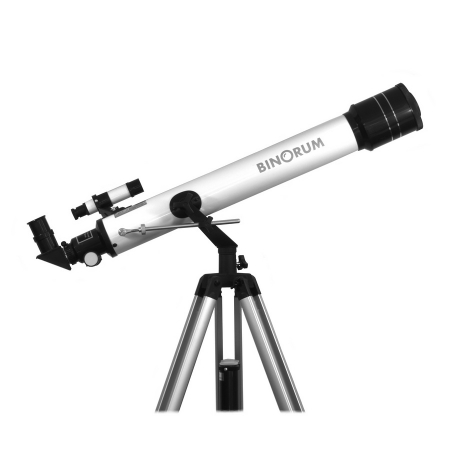
Finder Scopes for Astronomical Telescopes
Why Do You Need a Finder?
The main telescope has a narrow field of view - finding a specific object just by looking through the telescope is nearly impossible. A finder scope provides a wide field of view with lower magnification, allowing you to quickly point the telescope at the desired object. A quality finder is the difference between frustrating searching and efficient observing.
Types of Finders
Optical Finder Scopes
Function like a small telescope with crosshairs for precise object centering.
Straight-Through Finders
Simple and compact, but require bending when observing high in the sky. The image is usually inverted, complicating orientation with star charts.
Typical sizes: 5×24, 6×30, 7×50
Right-Angle Finders with 90° Eyepiece
The angled eyepiece enables comfortable viewing in a natural position. Most recommended type - eliminates uncomfortable neck positions. Modern models provide erect images matching star charts.
Typical sizes: 6×30, 8×50, 9×50
Advantages of right-angle finders:
- Comfortable viewing at all altitudes
- Reduced fatigue during long sessions
- Erect image matches charts
- Suitable for multiple observers
Red Dot Sights
Project a glowing red dot onto transparent glass. You look with both eyes at the actual sky and the dot shows the telescope's direction.
Advantages: Very simple to use, wide field, lightweight, inexpensive
Disadvantages: Don't work for faint objects, require batteries, less precise
How to Read Specifications?
The designation 8×50 means:
- 8× - magnification (higher sees fainter objects but narrows field)
- 50 - objective diameter in mm (larger gathers more light)
Recommended sizes:
- 6×30 - small telescopes (60-80mm), travel
- 8×50, 9×50 - universal for most telescopes
- 10×50, 11×56 - large telescopes (over 200mm)
Vixen Dovetail Base
The standard Vixen dovetail base is the most widespread mounting system. Used by Sky-Watcher, GSO, Binorum and most manufacturers. Enables quick mounting and finder exchange. Always check compatibility with your telescope when selecting.
Erect vs. Inverted Image
Inverted Image (inexpensive finders)
Moving left means image goes right, up means down. Very confusing for map navigation.
Erect Image (recommended!)
Modern finders provide correctly oriented images both vertically and horizontally. Movement matches charts and what you see with your eye. Navigation is intuitive and fast.
We recommend investing in erect image - the comfort difference outweighs the higher price.
Selection by Telescope Type
- Small refractors (60-80mm): 6×30 or red dot
- Medium telescopes (90-150mm): 8×50 or 9×50, right-angle with erect image
- Large telescopes (over 200mm): 9×50, 10×50 or 11×56
- Dobsonians: Right-angle 8×50 or 9×50 - practically mandatory
Aligning the Finder
- Point the telescope at a distant object (antenna, chimney)
- Use centering screws to adjust finder to same object
- At night, check on a bright star and fine-tune
- Tighten screws, but not too firmly
Solar Observing
NEVER point an unprotected finder at the Sun! For safe observation you need a solar filter on the outer side of the finder objective (e.g., Binorum SolidSun Metal 44-70mm).
Why Upgrade?
Upgrading to a quality right-angle finder with erect image brings:
- Dramatically higher observing comfort
- Faster object location
- Less fatigue, longer observing sessions
- Better visibility of faint objects
Frequently Asked Questions
Can I use a finder from another manufacturer?
Yes, if both have the same dovetail (usually Vixen).
Is a red dot sight sufficient?
For bright objects yes. For faint nebulae and galaxies you need an optical finder.
How often to align?
A quality finder holds alignment for months. Check after transport.
Recommendation
For most astronomers we recommend a right-angle 8×50 finder with erect image as the optimal combination of performance, comfort and price. Brands like Binorum ClearView, Sky-Watcher and GSO offer quality finders with Vixen dovetail bases at reasonable prices.
A quality finder is an investment that pays back with every observing session. The difference between frustrating searching and efficient observing often lies precisely in it.