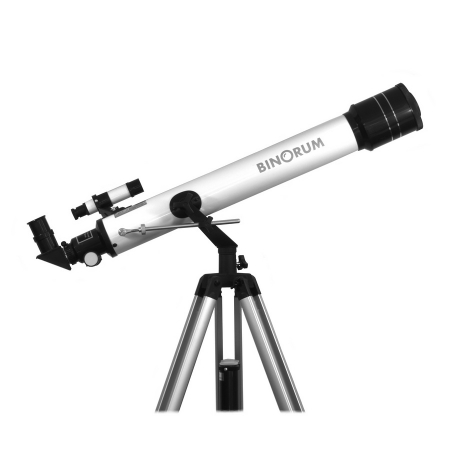
Optical Finder Scopes for Telescopes
Why Replace the Finder Supplied with Your Telescope?
Most astronomical telescopes come supplied with basic finders that, while functional, often represent a compromise between price and functionality. If you've found that locating objects in the sky is uncomfortable, difficult, or time-consuming, the problem isn't your skills - the problem is likely your finder.
A quality optical finder scope transforms the observing experience. Instead of frustrating object hunting, you'll spend time actually observing. Investment in a better finder pays back with every observing session for years of telescope use.
Typical Problems with Basic Finders
Finders supplied with telescopes often suffer from several shortcomings:
- Uncomfortable viewing position - straight-through finders force bending and neck-twisting, especially when looking high in the sky
- Confusing image orientation - inverted or mirror-reversed images complicate navigation with star charts
- Small objective - 5×24 finders gather little light, fainter stars aren't visible
- Poor optical quality - blurred images, low contrast, visible aberrations
- Low-quality mechanics - finder loses alignment during transport
Advantages of Quality Optical Finders
Right-Angle Finders for Maximum Comfort
The angled eyepiece with 90° viewing angle enables observing in a natural, comfortable position regardless of where the telescope points. No neck-twisting, no back-bending - just relaxed observing. This is particularly important during long observing sessions and absolutely crucial for Dobsonian telescopes or when viewing objects near the zenith.
Erect Image for Intuitive Navigation
Modern quality finders provide correctly oriented images both vertically and horizontally. Move the telescope left? The image moves left. Up truly means up. The image exactly matches star charts and planetarium programs. Star-hopping navigation becomes natural and fast - exactly as it should be.
Larger Objective = Brighter Image
Finders with 50mm objectives gather more than four times as much light as common 5×24 models. This means visibility of significantly fainter stars, critical for precise navigation to very faint deep-sky objects. A larger objective also provides a brighter, higher-contrast image overall.
Optimal Magnification
8× or 9× magnification represents the ideal balance - strong enough to confirm fainter objects while maintaining a wide field of view for easy sky scanning. You can see stars invisible to the naked eye while still having sufficient overview for quick orientation.
How to Choose the Right Finder?
By Telescope Size
- Compact telescopes (60-80mm): 6×30 finder - lightweight, won't burden small instrument
- Medium telescopes (90-150mm): 8×50 finder - most universal choice
- Large telescopes (over 200mm): 9×50 or larger finder - more light for faint objects
By Mounting Type
Nearly all modern telescopes (Sky-Watcher, GSO and others) use the standard Vixen dovetail base. Finders in our range are equipped with this base, ensuring instant compatibility. Simply remove the old finder, slide in the new one, align and start observing.
Straight-Through vs. Right-Angle Design
If you must choose only one upgrade, select a right-angle finder with erect image. The difference in comfort and observing efficiency is so dramatic that this investment pays back during the first observing evening. Straight-through finders have their place only with very compact travel telescopes where every gram is critical.
Alignment and Maintenance
All our optical finders are equipped with precision centering screws for easy alignment. After installation, simply point both telescope and finder at a distant daytime object and align them using the adjustment screws. Quality mechanics ensure the alignment holds for months of regular use.
The optics require virtually no maintenance - just protect from dust with lens caps (usually included) and if cleaning becomes necessary, use appropriate methods for optical glass.
Investment in Better Observing
A quality optical finder isn't a luxury - it's a practical necessity for efficient observing. While a basic finder forces you to spend significant observing time in futile object searching, a quality finder lets you quickly locate targets and devote yourself to what you love - observing the universe.
The price difference between basic and quality finders is relatively small compared to telescope cost, but the impact on observing experience is enormous. This is one of the most effective upgrades you can make for your telescope.
Our Recommendation
For most astronomers we recommend as a first upgrade a right-angle 8×50 finder with erect image. This combination provides optimal balance between performance, comfort and price. Smaller telescopes will appreciate the lighter 6×30, while owners of large instruments will benefit from 9×50 or even 10×50 for locating the faintest objects.
Browse our range of optical finders and discover how a simple change can fundamentally improve your observing experience.