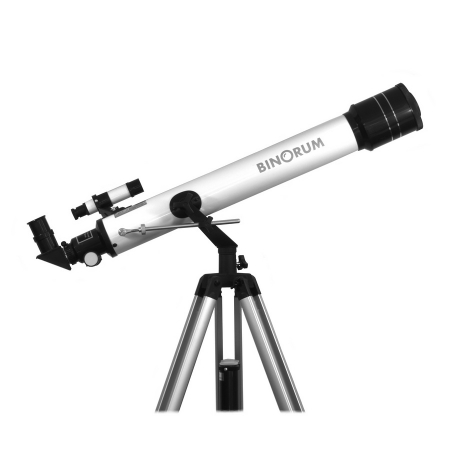
Discover New Horizons with Premium Optics — Binorum StarView 72/432 ED OTA
A powerful apochromatic refractor telescope perfect for astrophotography applications.
Optical Design
Apochromatic refractor featuring an ED (Extra-Low Dispersion) doublet objective lens with advanced chromatic aberration correction.
Key Technical Specifications
- Objective diameter (aperture): 72mm
- Focal length: 432mm
- Focal ratio: f/6
- Edge sharpness: Excellent (ED glass with chromatic aberration suppression)
- Distortion (coma, astigmatism): Minimal when used with field flattener
- Back focus distance: ≥ 55mm (sufficient for prime focus and use with reducers / cameras with APS-C / Full Frame sensors)
- Tube construction: Solid tube, dust-proof covers, internal anti-reflection coating with black material to prevent glare
Recommended Accessories for Astrophotography
Mount
Equatorial mount with precision drive (e.g., HEQ, EQ-X, or similar), ideally with guiding capability for long exposures.
Field Correction
Optional installation of field flattener to reduce distortion in edge areas of the image.
Cameras & Sensors
Compatible with both Full Frame and APS-C sensors. The back focus allows use of adapters for DSLR or astronomical cameras.
Focuser / Interchangeable Accessories
Quality focuser with travel distance ≥ 50mm, compatible with 2-inch eyepieces or reducers.
Filters
CLS, UHC, IR-cut, photometric filters, or color filters for effects (RGB) and filters for emission nebulae.
Advanced Use Benefits
Low chromatic dispersion thanks to ED glass improves sharpness and color accuracy at image edges — essential when photographing planets and fine details on the Moon.
Shorter focal ratio f/6 enables higher sensitivity in photometrically intensive processing, shorter exposure times, and wider field of view without significant chromatic blur.
Universal compatibility — the tube is designed to accommodate a wide range of sensors and cameras, allowing combination with DSLR, CMOS astro cameras, and specialized monochrome sensors.
Robust construction and easy handling — relatively lightweight for its size, suitable for mobile observatories or trips away from light pollution.
Operating Recommendations and Notes
Check the focusing mechanism beforehand — it must be rigid, without play, suitable for fine adjustments during long exposures.
Thermal stabilization: Allow the tube to acclimate outdoors before imaging to minimize optical aberrations and deformations caused by glass expansion.
When photographing galaxies or nebulae, we recommend using additional camera cooling (if possible) and/or dark/flat calibration — because even with good optics, artifacts can be caused by imperfect filters or reflections.
This ED astrophotography telescope is ideal for users who require a balanced ratio of light-gathering power, optical quality, and exposure time — perfect for visual work with planets, the Moon, and also entry-level astrophotography in wide fields.