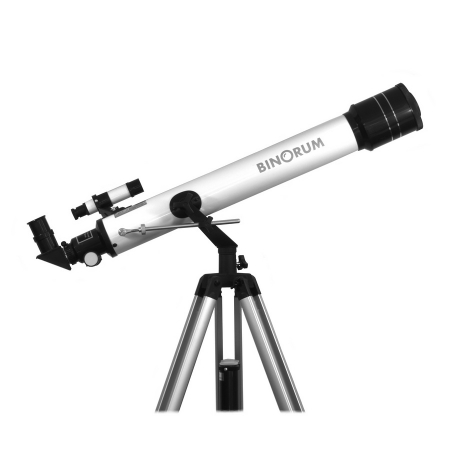
Sky-Watcher MAK 127/1500 2" OTA Telescope
The Sky-Watcher MAK 127 is an outstanding choice for astronomy enthusiasts seeking a compact, high-performance instrument for observing the Moon and the planets of the Solar System. With a 127 mm aperture and a focal length of 1500 mm folded into a tube just 32 cm long, it delivers the optical power of a large refractor in a package that fits into a backpack. Weighing around 3 kg without mount, this is a telescope that genuinely goes where you want to take it - while offering views that will impress even experienced observers.
This model is sold as an OTA (optical tube assembly only) - no mount is included. The tube features a built-in camera tripod socket, allowing it to be placed on a standard photo tripod for casual use. For the best experience, however, an astronomical mount of at least AZ4 (altazimuth) or EQ3-2 (equatorial) class is recommended, given the long focal length and the precision that planetary and lunar observation at high magnification demands.
Maksutov-Cassegrain Optical System
The optical system consists of a spherical meniscus corrector lens made from crown glass, a primary mirror, and a secondary mirror formed as an aluminised spot on the inner surface of the corrector. This classic Gregory-Maksutov arrangement produces significantly reduced coma and astigmatism compared to reflector designs, and eliminates chromatic aberration almost entirely. The result is exceptionally sharp and high-contrast images with none of the colour fringing that affects achromatic refractors.
The corrector lens carries Sky-Watcher's Metallic High-Transmission Coating (MHTC), while the primary mirror is polished and coated with Radiant Aluminum Quartz (RAQ) coatings achieving 94% reflectivity. These coatings work together to maximise the amount of light transmitted to the eyepiece and enhance the contrast and colour rendition of the final image.
The long focal ratio of f/12 brings an additional benefit: even modest, inexpensive eyepieces such as Plossls and Kellners perform excellently across the entire field at this focal ratio, eliminating the need for a large collection of premium oculars.
What You Can Observe
The MAK 127 gathers approximately 235 times more light than the dark-adapted human eye and can reveal objects down to magnitude 12.1 - comfortably beyond the naked-eye limit of magnitude 6. The optical resolution of 1.1 arc-seconds means close double stars separated by as little as that can be cleanly split.
On the Moon, the detail visible through a 127 mm Maksutov is remarkable. At 139x the terraced walls of large craters are clearly defined, small craterlets on the floors of Plato and Clavius come into view, and rille systems within major craters can be traced. The planetary targets are equally impressive: Jupiter reveals its equatorial cloud belts, the Great Red Spot, and the four Galilean moons as clearly distinct points. Saturn's rings and the Cassini Division within them are rendered with precision, and the planet's main moons are easily visible alongside it. Mars near opposition shows polar ice caps and prominent surface features, while Venus displays its full cycle of phases.
Contrary to common assumption, the MAK 127 performs well beyond the Solar System. The 127 mm aperture is enough to resolve globular clusters such as M13 in Hercules into individual stars across the core. Bright compact deep-sky objects respond well to the high magnification the telescope naturally favours: the Great Orion Nebula (M42), the twin galaxies M81 and M82 in Ursa Major, and the brighter planetary nebulae are all rewarding targets. The telescope is particularly well suited to urban environments, where light pollution limits the visibility of faint extended objects but does not significantly affect the Moon, planets, or compact high-surface-brightness deep-sky targets.
Build Quality and Focuser
The optical tube measures just 32 cm in length (145 mm in diameter) and is finished in Sky-Watcher's characteristic metallic black diamond coating. The build quality is solid throughout - the rear plate and lens ring are cast metal, and there is nothing fragile or lightweight about the construction. The primary mirror focusing mechanism is smooth and precise, with minimal image shift - an important characteristic for high-magnification planetary work. Three recessed collimation screws on the rear plate allow fine optical alignment if ever required.
The 2" focuser output accepts standard 2" accessories and is threaded for T-mount camera adapters, making the MAK 127 straightforward to use for prime focus lunar and planetary photography with a DSLR or mirrorless camera.
Included Accessories
- 28 mm 2" LET eyepiece - 54x magnification
- 90° star diagonal, 2"
- 6x30 straight-through finder scope
- Vixen-style dovetail plate for EQ/AZ mount compatibility
- Built-in 1/4" camera tripod socket
Key Specifications
- Optical design: Maksutov-Cassegrain
- Aperture: 127 mm
- Focal length: 1500 mm (f/12)
- Limiting magnitude: 12.1
- Optical resolution: 1.1 arc-seconds
- Light gathering vs. naked eye: 235x
- Magnification with included eyepiece: 54x
- Eyepiece barrel diameter: 2" (51 mm)
- Tube length: approx. 320 mm
- Tube diameter: 145 mm
- Weight: approx. 3 kg
- Recommended mount class: AZ4 (altazimuth) or EQ3-2 (equatorial) and above
- Mount: not included
Whether you are looking for a capable grab-and-go planetary telescope, a compact travel instrument to complement a larger home setup, or a high-performance OTA to pair with a GoTo mount - the Sky-Watcher MAK 127 delivers a combination of aperture, portability, and optical quality that is genuinely difficult to match in its size class.