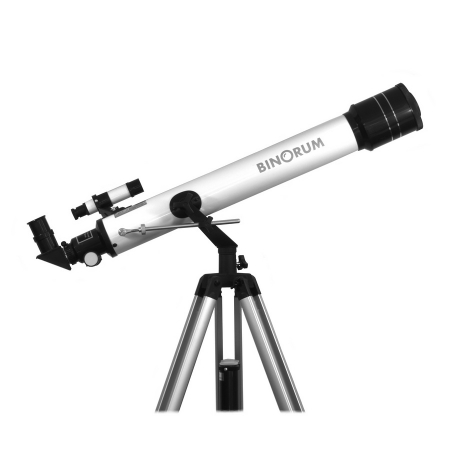
Binorum Genesis 76/600 AZ2 – The Perfect First Step to Discovering the Universe
Want to see the starry sky "up close" for the first time? This compact Newtonian telescope is an excellent choice for anyone just starting with astronomy. It allows you to explore craters and mountain ranges on the Moon in detail, admire Saturn's rings, glimpse planets, and even some star clusters and galaxies.
With a 76mm mirror diameter, it offers a surprisingly bright image, and combined with the included accessories, it opens the door to the entire solar system:
Two eyepieces and a Barlow lens let you choose different magnifications – from 28× up to 140×. Simply select what you want to focus on.
Easy operation – point the telescope, focus gently, and the starry sky is yours.
The telescope features a modern 1.25" focuser, so you can use other commonly available eyepieces as well. The aluminum tripod with adjustable height and simple azimuthal mount ensure comfortable viewing without unnecessary complications.
Elegant design, quality construction, and an affordable price make the Binorum Genesis 76/600 AZ2 the perfect first telescope for beginners who want to discover the beauty of the universe with their own eyes.
The package includes an astronomical telescope with tripod, moon filter, two eyepieces with different magnification levels, finderscope, and Barlow lens.
Specifications
Type of telescope:
Newton reflectors
Optical scheme:
Newton
Focal length:
700 mm
Aperture:
76 mm (3″)
Aperture ratio:
9.2
Resolving capacity:
1.51"
Limit value:
11.2 magnitude
Light gathering capacity:
117x
Max. useful magnification:
150x
Connection type:
1.25″
Mounting:
Azimuthal
Recommended for:
Beginner
Application area:
Deep Sky observation, Planets observation
Package contents of "Telescope Binorum Genesis 76/700 AZ2 + Moon filter":
✅ Telescope 76/700
✅ Tripod
✅ 1.25″ Kellner eyepiece 25mm (28x magnification)
✅ 1.25″ Kellner eyepiece 10mm (70x magnification)
✅ 2x Barlow lens (56x and 140x magnification)
✅ Moon filter
✅ 5x24 finderscope
Typical magnifications
The recommended magnification is highlighted in yellow.
D = telescope aperture in millimeters