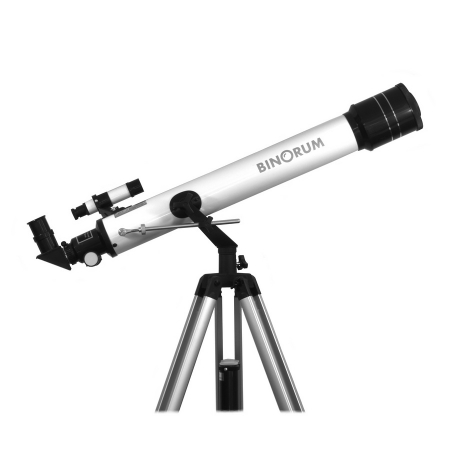
Refractor Telescopes - The Classic Design Perfected Over Centuries
Refractor telescopes, also known as refracting or lens telescopes, represent the oldest and most reliable type of astronomical telescope. Their principle is elegantly simple – light passes through a system of lenses that bend (refract) and focus it to create a magnified image of the observed object.
The first refractor was built by Galileo Galilei in 1609. Since then, the design has evolved dramatically – today's models utilize modern optical glasses, multi-layer anti-reflection coatings, and precise mechanical construction. The result is bright, high-contrast, detailed images that both beginners and advanced observers appreciate.
How Refractor Telescopes Work
A refractor telescope consists of two main components – the objective lens (front element) that gathers light, and the eyepiece that magnifies the image. Light from stars or planets enters the objective, refracts, and focuses at the focal point where a real image forms. This image is then magnified by the eyepiece, allowing the observer to see fine details invisible to the naked eye.
Unlike reflector designs (such as Newtonian or Cassegrain), the optical path is sealed, preventing dust and moisture from entering. Refractors therefore require virtually no maintenance or collimation and maintain image quality over the long term.
Who Should Choose a Refractor Telescope?
Refractors are the ideal choice for beginners, families, and young observers wanting to start astronomy without complicated preparation. Simply mount them, point at the sky, and observe. Thanks to excellent contrast and sharpness, they're also valued by advanced astronomers – especially for observing the Moon, planets, and double stars.
Smaller models (e.g., 70/700mm) are lightweight, easily portable, and serve perfectly as first telescopes for children or vacation observing. Larger apochromatic refractors (e.g., 100/900mm or 120/1000mm) enable high-quality astrophotography.
Advantages of Refractor Telescopes
Simple operation: No mirrors, no collimation, minimal maintenance required
Sealed optical system: Resistant to dust and moisture, long optical lifespan
High contrast and sharpness: No central obstruction in optical path – clean, bright images
Versatility: Suitable for observing Moon, planets, Sun (with filter), star clusters, and brighter nebulae
Maintenance-free operation: Simply set up and use – no adjustments needed
Classic appearance: Elegant long tube evokes traditional astronomical telescopes
Excellent for light-polluted areas: High contrast helps combat urban light pollution
Terrestrial use: Add diagonal prism for correctly oriented daytime viewing
Types of Refractor Telescopes
Achromatic Refractors
The most common and affordable type. A pair of lenses made from different glass types corrects most chromatic aberration. They provide sharp images with minimal color fringing that's typically unnoticeable during visual observation.
Best for: Beginners, general astronomy, lunar and planetary observation, budget-conscious observers
Typical configurations: 60/700mm, 70/700mm, 80/900mm, 90/1000mm
Apochromatic Refractors (APO)
Premium category refractors using three or more lens elements. They completely eliminate chromatic aberration and offer images with perfect color rendition – ideal for astrophotography and demanding observers.
Best for: Serious astrophotography, critical planetary observation, observers demanding ultimate image quality
Typical configurations: 80/600mm, 100/900mm, 120/1000mm, 150/1200mm
ED Refractors (Semi-APO)
Middle class between achromat and apochromat. They use special extra-low dispersion (ED) glass that improves color correction and increases contrast. Excellent choice for advanced amateur astronomers seeking better performance than achromats without APO pricing.
Best for: Advanced visual observers, beginning astrophotographers, serious planetary observers
Typical configurations: 80/600mm ED, 102/1000mm ED
How to Choose the Right Refractor
Aperture (Objective Diameter)
Determines the telescope's light-gathering power:
60-80mm: For beginners and children. Portable, affordable, adequate for Moon, bright planets, and star clusters
90-120mm: Universal models offering significantly more light. Excellent for detailed planetary observation and brighter deep-sky objects
120mm and larger: For demanding deep-sky observation and serious astrophotography. Reveal faint details in nebulae and galaxies
Focal Length and Focal Ratio
Short focal length (f/5-f/6): Wide field of view, excellent for large nebulae, star fields, and astrophotography of extended objects
Long focal length (f/10-f/13): Ideal for planets and Moon, providing high magnification and excellent detail. Longer tube may be less portable
Medium focal length (f/7-f/9): Versatile all-around choice balancing field width and magnification capability
Mount Type
Alt-azimuth (AZ) mount: Simple up-down, left-right movement. Easy for beginners, quick setup, intuitive operation. Perfect for casual observing
Equatorial (EQ) mount: Aligned with Earth's rotation axis. Enables smooth tracking with single-axis movement. Essential for astrophotography, beneficial for extended visual sessions
Quality Accessories
Quality eyepieces, star diagonal, sturdy tripod, and accessories like Barlow lenses or solar filters improve comfort and observing results. Many refractors include starter accessories, but upgrades significantly enhance performance.
When to Choose a Refractor Telescope
A refractor is an excellent choice if you:
- Want a maintenance-free telescope for frequent use
- Plan to observe Moon, planets, and double stars
- Need quickly-ready equipment without collimation
- Seek a universal telescope for terrestrial observing too
- Want a compact telescope for vacation or cottage use
- Observe from light-polluted urban areas
- Prefer elegant, traditional telescope appearance
- Value long-term reliability and durability
However, if you want to observe very faint deep-sky objects (galaxies, nebulae), a Newtonian reflector with larger aperture may be more suitable. For typical visual observation, though, refractors are an outstanding choice.
What You Can See with a Refractor
The Moon
Even small 60-70mm refractors reveal thousands of craters, mountain ranges, and maria. Larger refractors show incredible detail – crater terraces, central peaks, rilles, and delicate shadows during terminator viewing.
Planets
Jupiter: Cloud bands, Great Red Spot (when visible), four Galilean moons and their transits across the disk
Saturn: Rings with Cassini Division (in 80mm+), cloud bands, Titan and other moons
Mars: Polar caps, major dark features like Syrtis Major during opposition
Venus: Phases from crescent to nearly full, brilliantly bright
Deep-Sky Objects
While refractors don't gather as much light as large reflectors, they excel at brighter targets:
• Double stars with crisp, clean separation
- Open clusters like Pleiades and Hyades
- Brighter nebulae like M42 (Orion Nebula)
- Globular clusters showing outer star resolution
- Brighter galaxies like M31 (Andromeda)
The Sun (With Proper Filter)
With appropriate solar filter, observe sunspots, faculae, and solar activity safely. Never observe the Sun without proper filtration!
Tips for Using Your Refractor
Thermal equilibrium: Before observing, allow the telescope to cool briefly for more stable images, especially with larger refractors
Dark observing sites: Even small refractors surprise when used away from light pollution
Start low, go slow: Begin with lower magnification and gradually increase based on atmospheric conditions
Minimal cleaning: Clean optics only when necessary, gently with dry microfiber cloth
Dew prevention: Use dew shields or gentle heating to prevent moisture condensation on objective
Storage: Keep in dry environment with caps on when not in use
Refractors vs. Reflectors
Choose refractor if you prioritize:
- Low maintenance and ease of use
- High contrast planetary views
- Sealed optics resistant to dust
- Compact, portable design
- No collimation requirements
- Traditional telescope aesthetics
Choose reflector if you prioritize:
- Maximum aperture for budget
- Faint deep-sky object observation
- Largest light-gathering capability
- Don't mind periodic collimation
- Have adequate storage for larger tube
Astrophotography with Refractors
Apochromatic and ED refractors are highly regarded for astrophotography due to:
- No diffraction spikes from secondary mirror spider
- Excellent color correction across field
- Flat field (with field flattener accessory)
- No tube currents affecting image
- Compact, easily mounted on tracking systems
- Pinpoint star images across frame
Short focal length APO refractors (f/5-f/7) are particularly popular for wide-field nebula and galaxy imaging.
Our Refractor Collection
We offer carefully selected refractor telescopes from renowned manufacturers, ensuring quality optics, reliable mechanics, and excellent value. From entry-level achromats for beginners to premium APO refractors for astrophotography – find the model that opens your gateway to the universe.
Every refractor in our collection has been evaluated for optical quality, mechanical stability, and practical usability. We stock models suitable for:
- Children's first telescopes
- Family astronomy
- Serious amateur observation
- Advanced astrophotography
- Portable travel scopes
- Backyard observatory instruments
Expert Guidance Available
Not sure which refractor suits your needs? Our knowledgeable team can advise based on:
- Your observing interests and targets
- Experience level and technical comfort
- Portability requirements
- Budget and long-term plans
- Astrophotography goals (if applicable)
Invest in Timeless Quality
Refractor telescopes represent the union of tradition, simplicity, and precision optics. With their sealed construction, easy operation, and high contrast, they're the ideal choice for anyone wanting to explore the night sky without complicated maintenance.
Whether you're seeking a beginner's telescope, an elegant refractor for children, or a quality APO for astrophotography – our collection offers models that will open the gateway to the universe for you.
Explore our refractor telescope collection and discover why these classic instruments remain the first choice for millions of astronomers worldwide.