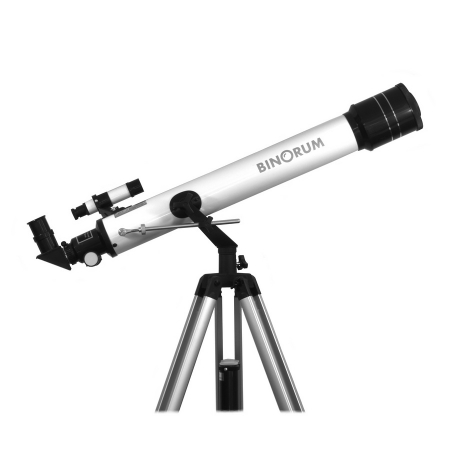
Vixen R130Sf 130/650 reflector telescope on Porta II AZ mount
The Vixen R130Sf 130/650 on the Porta II azimuth mount is a well-rounded optical instrument that suits a wide range of observers - from those just starting out in astronomy to experienced enthusiasts looking for a compact and capable travel scope. Combining a fast f/5 parabolic Newtonian optical tube with one of the most user-friendly alt-azimuth mounts on the market, this setup delivers sharp, bright views with minimal setup time.
Optical design and performance
The R130Sf uses a classical Newtonian reflector layout built around a 130 mm parabolic primary mirror with a focal length of 650 mm, giving a focal ratio of f/5. The parabolic figure eliminates spherical aberration that is inherent in simpler spherical mirrors, resulting in pinpoint stars across the entire field of view and crisp planetary detail at the center.
The secondary mirror is sized to minimise central obstruction while still fully illuminating standard 1.25″ and 2″ eyepieces, which helps maintain good contrast - particularly important when observing planets and the Moon. The interior of the metal optical tube is finished in matte black to suppress internal reflections and stray light.
The focuser is a 2″ rack-and-pinion unit with a 1.25″ adapter included, providing smooth focusing action compatible with a wide range of eyepieces and accessories.
Porta II azimuth mount
The Porta II is a well-known and respected alt-azimuth mount from Vixen, designed with simplicity and practical usability in mind. It moves in two axes - altitude (vertical) and azimuth (horizontal) - with smooth, adjustable slow-motion controls on both axes. This allows precise object tracking and fine positioning without the complexity of an equatorial setup.
Key features of the Porta II mount include:
- Dual-axis slow-motion cables for smooth manual tracking
- Quick-release dovetail clamp compatible with Vixen-style dovetail bars
- Adjustable tripod legs with a central accessory tray
- Tool-free assembly in a matter of minutes
- Solid aluminium construction with a stable, wide-leg stance
The mount is rated for optical tubes weighing up to approximately 4 kg, making it a good match for the R130Sf tube. It is not motorised in the standard configuration, but Vixen offers an optional dual-axis motor drive kit for automated tracking if needed.
What can you observe
With 130 mm of aperture and a fast focal ratio, the R130Sf is genuinely capable across a broad range of targets:
- Moon and planets - the parabolic mirror resolves fine lunar craters, ridges and rilles with impressive clarity. Jupiter shows cloud belts and the Galilean moons; Saturn's rings and the Cassini Division are clearly visible; Mars near opposition reveals polar caps and surface markings.
- Open clusters - objects like the Pleiades (M45), the Double Cluster in Perseus (NGC 869/884), and M44 (Beehive Cluster) are beautifully resolved across a wide field.
- Brighter globular clusters - M13 in Hercules and M22 in Sagittarius begin to resolve into individual stars at higher magnifications.
- Galaxies - M31 (Andromeda Galaxy), M81 and M82 in Ursa Major, and the Leo Triplet are all within reach from a reasonably dark site.
- Emission and planetary nebulae - the Orion Nebula (M42), the Ring Nebula (M57) and the Dumbbell Nebula (M27) present well, especially with a narrowband or UHC filter.
Portability and ease of use
One of the most practical aspects of this setup is its portability. The total system weight is under 12 kg, which means it can travel comfortably in a standard passenger car. Assembly requires no tools and takes only a few minutes, making it an excellent choice for observing sessions away from home - dark sky sites, camping trips or star parties.
The intuitive alt-azimuth mount means there is no polar alignment required. Simply set up the tripod, attach the tube, and start observing. This makes the system especially attractive for beginners, while still being a genuinely useful second instrument for more experienced observers.
Recommended accessories
The R130Sf is supplied with a basic eyepiece set, but performance can be meaningfully extended with additional accessories:
- A 25 mm wide-field eyepiece for low-power, wide-field views of clusters and large nebulae
- A 15 mm eyepiece for general-purpose mid-power observing
- A 9 mm or 6 mm eyepiece for planetary and lunar detail
- A 2x Barlow lens to double the effective magnification of any eyepiece in the collection
- A UHC or narrowband nebula filter to enhance contrast on emission nebulae
- A red-dot finder or Telrad for quick and easy target acquisition
Technical specifications
| Parameter |
Value |
| Optical design |
Newtonian reflector |
| Primary mirror diameter |
130 mm |
| Focal length |
650 mm |
| Focal ratio |
f/5 |
| Mirror type |
Parabolic |
| Focuser |
2″ rack-and-pinion with 1.25″ adapter |
| Maximum useful magnification |
approx. 260x |
| Limiting stellar magnitude |
approx. 13.1 mag |
| Optical tube length |
approx. 680 mm |
| Optical tube weight |
approx. 2.5 kg |
| Mount type |
Porta II alt-azimuth |
| Tripod |
Aluminium, adjustable height |
| Total system weight |
approx. 10-12 kg |
| Dovetail compatibility |
Vixen-style dovetail |
| Motorisation |
Optional (dual-axis motor drive available separately) |
Who is this telescope for
The Vixen R130Sf on the Porta II is a well-balanced choice for:
- Beginners who want a capable, easy-to-use first telescope that will not be outgrown quickly
- Intermediate observers looking for a lightweight visual instrument for regular use
- Experienced astronomers who want a compact and reliable grab-and-go telescope for travel or quick observing sessions
- Anyone who values optical quality and build quality from a well-established Japanese optics manufacturer
Vixen has been producing precision optical instruments in Japan since 1949 and has a long-standing reputation for mechanical quality and consistent optical performance. The R130Sf and Porta II combination reflects that heritage - it is a no-compromise instrument at its price point, built to last and designed for practical use in the field.