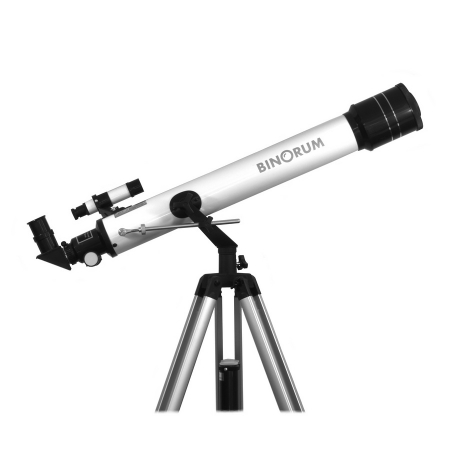
Bresser AC 80/640 Messier AZ Nano Astronomical Telescope + Solar Filter
The Bresser AC 80/640 Messier AZ Nano is a compact refractor telescope specifically designed for beginning astronomers who are looking for a reliable and easy-to-use instrument for their first steps in space observation. The telescope features a high-quality achromatic objective lens with an 80mm diameter and 640mm focal length (f/8), equipped with anti-reflection coatings for improved light performance. Thanks to its construction, it offers 31% greater light-gathering power than telescopes with 70mm objective lenses, resulting in brighter and more contrasted observations.
Mount and Stability Features
The telescope is mounted on a practical single-arm fork-style azimuthal mount type "Bresser NANO," which is equipped with ergonomic handles for smooth and precise guidance of the telescope to observed objects. The steel tripod with adjustable height provides a stable foundation for observation and is complemented by a practical support brace that simultaneously serves as a storage shelf for astronomical accessories. The total weight of only 5.5 kg makes this telescope an ideal companion for travel and astronomical expeditions.
Standard Equipment and Accessories
The basic equipment includes an SP 26mm eyepiece providing 25x magnification, a diagonal mirror for comfortable observation, a Red Dot finder for easy targeting of observed objects, and an adapter for connecting a DSLR camera (T-ring must be purchased separately). The package also includes a smartphone holder allowing photography and video recording of observed objects. For orientation on the night sky, a rotating star chart and CD with sky map are included.
Observation Capabilities
The telescope is ideal for moon and planet observation within the solar system, where it can reveal fascinating details of lunar craters, Jupiter's bands, or Saturn's rings. The maximum recommended magnification under ideal conditions reaches approximately 150x, although at such magnifications, additional stabilization may be needed. For higher magnifications, we recommend purchasing additional eyepieces, as well as planetary filters to enhance planetary details.
Performance and Applications
The Bresser AC 80/640 Messier AZ Nano is a universal tool for astronomical observation with emphasis on planetary objects and brighter deep-sky objects. Thanks to its compactness and easy operation, it's a perfect choice for beginners who want to familiarize themselves with the basics of practical astronomy. The telescope enables observation of lunar phases and details, solar system planets, brighter star clusters, nebulae, and galaxies. With proper solar filters, you can also observe sunspots and solar activity.
User-Friendly Design
The system is designed for quick assembly and easy handling, which you'll especially appreciate during observations at various locations or when transporting to astronomical events. The azimuthal mount provides intuitive control in altitude-azimuth directions, which is much more understandable for beginners than more complex equatorial systems. The included solar filter expands observation possibilities to include daytime phenomena on our nearest star.
Technical Specifications
- Optical design: Achromatic refractor
- Objective diameter: 80mm
- Focal length: 640mm
- Focal ratio: f/8
- Mount type: Azimuthal fork mount
- Total weight: 5.5 kg
- Maximum useful magnification: ~150x
- Light gathering power: 31% more than 70mm telescopes
About Bresser Brand
Bresser is a renowned German brand with more than 70 years of tradition in the field of optical instruments and astronomical technology. The company specializes in the development and manufacture of quality telescopes, microscopes, and other optical equipment for scientific and educational purposes. Bresser products are characterized by reliable construction, precision optics, and excellent price-to-quality ratio, making them a popular choice for both beginning enthusiasts and advanced users. The Bresser brand continuously innovates its products with emphasis on modern technologies and user-friendliness, while remaining true to its philosophy of making science and knowledge accessible to a wide spectrum of people interested in astronomy and microscopy.