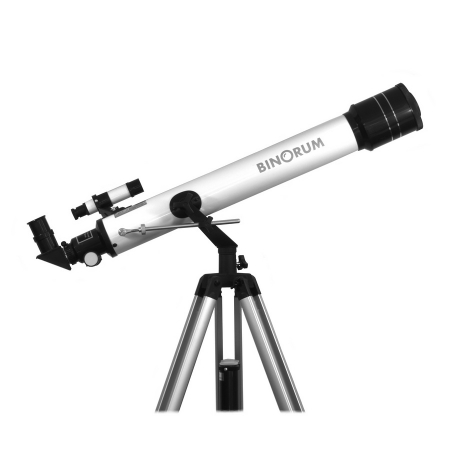
Omegon Maksutov MightyMak 60/700 Desktop Telescope
Some telescopes do one thing well. The MightyMak does many. This compact Maksutov will show you Saturn's rings on a clear evening, then help you watch birds in the meadow or a deer at the forest's edge the next morning. Its shorter focal length - compared to similar models - produces a brighter image and a wider field of view. That is an advantage you will notice whether you are exploring the night sky or watching wildlife. The short tube fits easily into a bag, so the MightyMak genuinely travels with you.
Sharp views of planets and beyond
Jupiter's largest moons are easy to spot, and the planet's cloud bands stand out clearly. Saturn reveals its majestic rings - a sight that never loses its impact, even after your tenth observation. The anti-reflection coating on the front lens reduces unwanted reflections, keeping the image sharp and contrastful even at higher magnifications. This Maksutov telescope for planetary observation delivers remarkable performance in a compact body that rivals instruments many times its size.
Photography-ready with T-2 connection
The MightyMak is not only for visual use. Thanks to its T-2 thread with a compensation ring, you can turn it into a long-focal-length telephoto lens in minutes. Simply add the correct T-ring for your camera and start photographing the Moon, planets, or distant subjects in nature. The compensation ring ensures a precise and stable connection with no play. The standard GP rail allows mounting on common photographic tripods and astronomical mounts with a GP profile, so the MightyMak slots smoothly into the equipment you already own.
Everything you need from the first moment
The box includes everything you need for your first observation session - a desktop tripod, an eyepiece, and a carry bag. There is nothing extra to buy and no compatibility issues to sort out. The MightyMak is ready to use straight away. A finderscope rail is also included, so you can add a finderscope of your choice whenever you are ready to expand your setup. The elegant gloss-black finish with gold accent lines makes this a telescope that looks as good as it performs.
Key features at a glance
- Compact Maksutov design - suitable for astronomy and nature watching
- Shorter focal length for a brighter image and wider field of view
- Anti-reflection coating on the front lens for sharp, high-contrast views
- T-2 thread with compensation ring for DSLR and mirrorless cameras
- Standard GP rail - compatible with photographic tripods and astronomical mounts
- Complete starter set included - desktop tripod, eyepiece, and carry bag
- Finderscope rail for optional accessories
- Gloss-black body with gold accent lines
Technical specifications
| Parameter |
Value |
| Optical design |
Maksutov-Cassegrain |
| Aperture |
60 mm |
| Focal length |
700 mm |
| Focuser connection |
T-2 thread with compensation ring |
| Mount rail |
Standard GP profile |
| Included |
Desktop tripod, eyepiece, carry bag |
| Finderscope rail |
Yes |
| Colour |
Gloss black with gold accents |
Who is the MightyMak for?
The MightyMak suits beginners who want a versatile first telescope as well as experienced observers looking for a compact travel instrument. If you want to observe planets, watch nature, and experiment with astrophotography - all with a single compact telescope - the MightyMak is an excellent choice.
Specifications
Type of telescope:
Newton reflectors
Optical scheme:
Maksutov
Focal length:
700 mm
Aperture:
60 mm (2.36″)
Aperture ratio:
11.7
Resolving capacity:
2.3"
Limiting magnitude:
11.1 magnitude
Light gathering capacity:
73x
Product range:
MightyMak
Max. useful magnification:
120x
Connection type:
1.25″
Mounting:
Table
Recommended for:
Beginner
Application area:
Planets observation, Nature observation
Package contents of "Telescope Omegon Maksutov MightyMak 60/700 Desktop":
✅ Telescope 60/700 MAK
✅ Table tripod
✅ Eyepiece K 25 mm (1.25″)
✅ Astronomical mirror 90° (1.25″)
✅ Vixen-Style rail (GP)
✅ Carrying bag
Typical magnifications
The recommended magnification is highlighted in yellow.
D = telescope aperture in millimeters